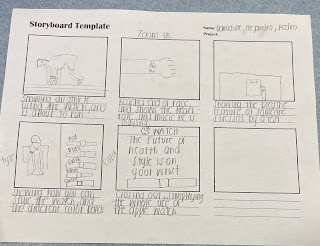
scene 1: showing an athlete using the watch , and is about to run scene 2: Reaches the end of the race, and Shows the heart rate, and the music that he is playing scene 3: showing the breath features of someone that I stressed by a test scene 4: showing how you style the watch, and the different color bands scene 5: closing out, sampling the whole use of the apple Watch
Our film hopes to have a surprise unexpected twist and in search of maximizing our chances of creating a good suspenseful scene we researched the mystery genre.. The camera angles, movements, and shots commonly used in mystery consist of: High and low angles, Close-up and Extreme Close-up shots, Dolly movements, over the shoulder shots, and POV shots. Directors like to use high angles to prove authority and power. Low angles are used to show weakness and fear. The whole idea in mystery movies is to show the suspense and fear of the characters, and the camera angles are very important. Close-ups and extreme close-ups are used so the audience can convey the emotions and allow the audience to kind of depict the characters mindset, can be used to give another meaning behind a character's words. Dolly Movements create a feeling of tension and urgency. Over the shoulder shots show either what's lingering in the back or we can get a point of view of what's going on in from of the ...
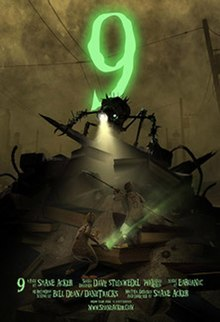
The first film was produced in 2005 and is a short film. 9 is a 2005 computer animated science fiction short film created by Shane Acker as a student project at the UCLA Animation Workshop. Tim Burton saw the film and later produced a feature-length adaptation also titled 9 in 2009, directed by Acker and distributed by Focus Features. 9 is a rag doll who appears to be the last of his kind, living in the ruins of a decaying, post-apocalyptic Earth. Hunting 9 is the Cat Beast, a mechanical monster wearing a cat's skull for a head. It appears to be guided by a small glowing talisman which it holds in its claws. 9 (the full film) is also a computer-animated science film directed by Shane Acker, written by Pamela Pettler and produced by Jim Lemley, Tim Burton, and Dana Ginsburg. A scientist is ordered by his dictator to create a robot in the apparent name of progress, and so the scientist creates the B.R.A.I.N., a highly intelligent robot. The dictator seizes it upon...

Comments
Post a Comment